


Addiction counselors working in correctional facilities, drug courts, probation settings, and other criminal justice environments often pursue a specialized credential that reflects that focus. The most widely recognized version of this credential is the CCJP (Certified Criminal Justice Addictions Professional), issued by the IC&RC. Some states and organizations refer to this same credential category as the CJCA (Criminal Justice Counselor Addictions) credential. This guide covers what is required, how to prepare for the exam, and what renewal looks like.
Table of Contents
What Is the Criminal Justice Addictions Credential?
The IC&RC Certified Criminal Justice Addictions Professional (CCJP) is the credential for substance use disorder counselors who specialize in criminal justice settings. It is a specialty credential, meaning it builds on top of an existing SUD credential (typically an ADC or equivalent state certification) rather than replacing it.
Counselors working in these settings typically hold a CADC, CDCA, CSAC, LCDC, or comparable state credential, and then add the CCJP to reflect their criminal justice specialization.
Who Needs This Credential?
The CCJP and equivalent criminal justice addictions credentials are relevant for counselors working in:
- County jails and state correctional facilities
- Drug courts and diversion programs
- Probation and parole offices
- Community corrections programs
- Reentry and transitional housing services
- Juvenile justice settings
- Court-mandated treatment programs
Some programs require counselors in these settings to hold a criminal justice addictions credential in addition to their standard SUD certification. Others use it as a hiring preference or professional development pathway.
CCJP Certification Requirements
Existing Credential Requirement
The IC&RC CCJP requires that you already hold a recognized SUD credential. Accepted base credentials include the ADC (Alcohol and Drug Counselor), AADC (Advanced Alcohol and Drug Counselor), or a state equivalent recognized by IC&RC.
If you are just entering the field and do not yet hold an SUD credential, the starting point is your state’s entry-level certification (CDCA in Ohio, LCDC in Texas, CADC (formerly CSAC) in NC, CADC in many other states), not the CCJP directly.
CCJP-Specific Additional Requirements
Because the CCJP is a specialty credential built on top of an existing ADC, AADC, or state-equivalent SUD credential, the broad SUD work-experience requirement is satisfied by that prerequisite credential. The CCJP itself adds three specialty requirements on top:
- Criminal justice work experience: 2,000 hours of work experience in criminal justice settings (corrections, drug court, probation, reentry, etc.)
- Education in CCJP domains: 100 hours of education specific to the CCJP performance domains
- Supervision in CCJP domains: 100 hours of supervision specific to the CCJP domains, with a minimum of 10 hours in each domain
Content areas for the 100 hours of CCJP-domain education include:
- Criminal justice system orientation and culture
- Assessment and treatment planning for justice-involved clients
- Substance use and crime co-occurrence
- Screening instruments used in CJ settings (AUDIT, DAST, TCUDS, LSI-R)
- Legal concepts relevant to addiction counseling
- Trauma-informed practices with justice-involved populations
- Reentry planning and community resources
CEU Matrix’s NAADAC-approved course library offers courses relevant to criminal justice addictions topics, including co-occurring disorders, trauma-informed care, and substance use assessment, all through NAADAC (Provider #6310) and IC&RC approval.
Examination
The IC&RC CCJP exam tests applied knowledge across the criminal justice addictions competency domains. Consult the current CCJP Candidate Guide for exam format details (question count, scored vs. pretest items, and time limits), as these can change between cycles.
Topics covered include:
- Assessment of justice-involved clients
- Case management within the criminal justice system
- Substance use treatment in correctional and community settings
- Professional ethics in CJ settings (dual role issues, confidentiality with courts, reporting requirements)
- Relapse prevention and reentry planning
- Collaboration with courts, probation officers, and other CJ system professionals
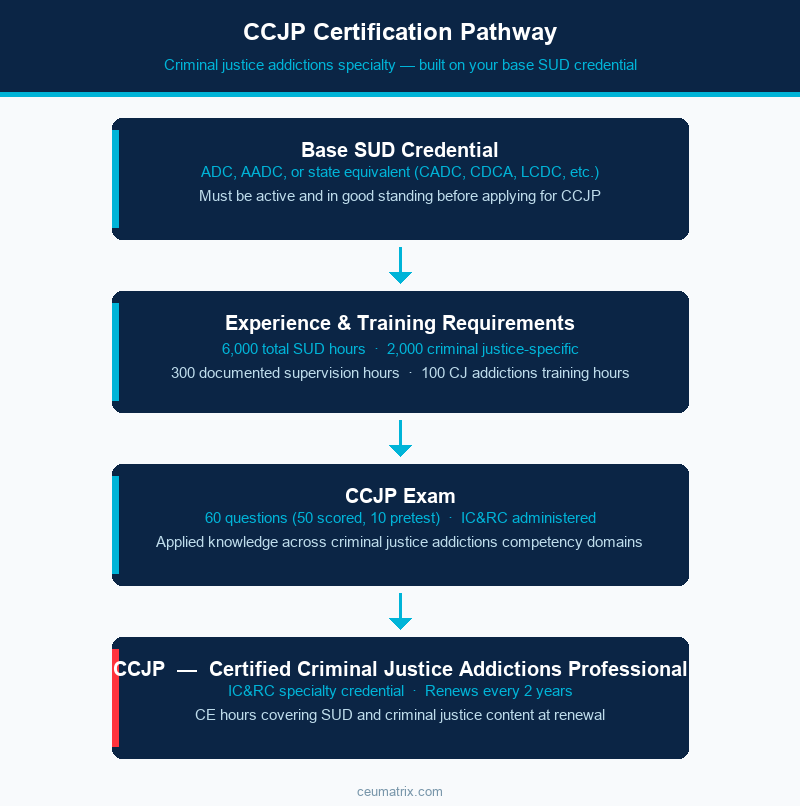
CCJP Requirements at a Glance
| Requirement | Detail |
|---|---|
| Prerequisite credential | Active ADC, AADC, or state equivalent (e.g., CADC, CDCA, LCDC) |
| Criminal justice work experience | 2,000 hours in CJ settings |
| Education in CCJP domains | 100 hours |
| Supervision in CCJP domains | 100 hours (minimum 10 hours per domain) |
| Exam | See the current CCJP Candidate Guide for format |
| Renewal | 40 hours of continuing education every 2 years |
CCJP Exam Prep
The CCJP exam is more specialized than the general ADC exam. Most candidates who struggle on the CCJP do so because of unfamiliarity with criminal justice system concepts, not SUD knowledge deficits.
Effective prep approaches:
- Review the IC&RC CCJP candidate guide, which lists the exam domains and their weights
- Study dual-role and confidentiality ethics specific to CJ settings, which differ from standard SUD counseling ethics in important ways
- Understand screening tools used in criminal justice settings (LSI-R, COMPAS, RANT, TCUDS II)
- Practice with case scenarios involving reentry clients, court-mandated treatment, and probation/parole coordination
- Complete continuing education in criminal justice-specific topics before sitting for the exam
Hours from a provider that is not on the IC&RC or NAADAC-approved list will not count at renewal, regardless of how relevant the content is.
Renewal Requirements
The CCJP renews every two years and requires 40 hours of continuing education per IC&RC, including both general SUD content and criminal justice-specific training. Member boards can layer additional requirements on top, so confirm any state-level specifics with your member board at renewal time.
CEU Matrix offers relevant renewal courses covering criminal justice topics, ethics, and co-occurring disorders that qualify for IC&RC approved CE credit.
Common Questions
Can I hold the CCJP without a base SUD credential? No. The CCJP requires an existing IC&RC-recognized SUD credential as a prerequisite.
Does the CCJP satisfy state credentialing requirements in criminal justice programs? This varies by state and by the type of program. Some states have their own criminal justice addictions credential (such as the CCJP through state-level boards) that may differ from the IC&RC CCJP. Verify with your state board what is required for your specific setting.
What if my criminal justice hours predate my SUD credential? IC&RC sets eligibility guidelines on how hours are counted. Contact IC&RC directly to confirm whether pre-credential hours in CJ settings qualify toward the experience requirement.
Starting the Process
If you are working toward this credential, the priority sequence is: earn your base SUD credential first, accumulate the 2,000 hours of CJ-specific work experience in a qualifying setting, complete the 100 hours of CCJP-domain education and 100 hours of CCJP-domain supervision (with at least 10 hours in each domain), then apply for the CCJP through IC&RC or your member board.
Assessment Tools Used in Criminal Justice Settings
Counselors pursuing the CCJP are expected to demonstrate working knowledge of the screening and assessment instruments standard in criminal justice contexts. These tools appear on the exam and are used daily in correctional facilities, drug courts, and community supervision programs.
Substance Use Screening Tools
AUDIT (Alcohol Use Disorders Identification Test) is a 10-item screening tool developed by the World Health Organization to identify hazardous and harmful alcohol use. It is widely used in intake assessments across CJ programs because of its brevity and validated scoring thresholds.
DAST (Drug Abuse Screening Test) parallels the AUDIT but focuses on drug use. It screens for the presence and severity of drug-related problems and is used alongside the AUDIT for comprehensive substance use screening at intake.
ASI (Addiction Severity Index) is a structured clinical interview covering seven domains: medical, employment, alcohol, drug, legal, family/social, and psychiatric. It produces composite severity scores that inform treatment planning and is one of the most widely used instruments in SUD treatment settings, including those embedded in the justice system.
Risk and Needs Assessment Tools
TCUDS II (Texas Christian University Drug Screen II) was developed specifically for criminal justice populations. It screens for drug use severity and dependence indicators and is particularly useful during reentry planning and in diversion program intake processes.
LSI-R (Level of Service Inventory Revised) is a risk and needs assessment instrument that measures static and dynamic risk factors associated with recidivism. It evaluates 54 items across domains including criminal history, education/employment, financial situation, family/marital, accommodation, leisure/recreation, companions, alcohol/drug problems, emotional/personal, and attitudes/orientation. The LSI-R informs supervision level decisions and case management priorities in probation and parole settings.
RANT (Risk and Needs Triage) is a brief assessment designed for rapid triage in criminal justice settings. It places individuals into one of four quadrants based on substance use severity and criminal risk, allowing programs to match clients to appropriate supervision and treatment intensity efficiently.
Algorithmic and Co-Occurring Disorders Tools
COMPAS (Correctional Offender Management Profiling for Alternative Sanctions) is a risk assessment tool used by courts, corrections departments, and supervision agencies to assess recidivism risk across multiple domains. It informs sentencing, supervision planning, and release decisions. COMPAS has been the subject of significant legal and ethical scrutiny regarding algorithmic bias, making it a topic criminal justice counselors are expected to understand within its proper context.
Beyond these instruments, co-occurring disorders screening is increasingly expected as a standard of practice in CJ settings. The MINI (Mini International Neuropsychiatric Interview) and PCL-5 (PTSD Checklist for DSM-5) are commonly used to identify psychiatric diagnoses and trauma-related symptoms in justice-involved populations. The CCJP exam tests knowledge of when and how to apply these instruments, not just their names.
CEU Matrix offers IC&RC-approved courses covering assessment tools and co-occurring disorders, designed specifically for counselors building competency in these areas.
Ethics in Criminal Justice Counseling: What Makes It Different
The ethical environment in criminal justice counseling is structurally different from standard SUD treatment settings, and the CCJP exam reflects that. Counselors entering this field need to understand how their ethical obligations shift when a client is under court supervision.
Dual Role and Reporting Obligations
Dual role conflicts are the defining ethical challenge of CJ counseling. The counselor serves a therapeutic function but often also carries a monitoring and reporting function toward courts, probation officers, and other criminal justice authorities. These roles can pull in opposite directions. Building therapeutic rapport requires trust and confidentiality; compliance monitoring requires transparent reporting to third parties.
Managing this tension without compromising clinical integrity or legal obligations is a core competency.
Mandatory reporting to courts and probation officers is a routine part of practice in most CJ settings. Counselors are often required to report treatment attendance, compliance with program requirements, positive drug screens, and rule violations. Clients must be informed of this at intake, but clients may not fully internalize the limits of confidentiality until they experience a disclosure. Clear documentation of what was communicated to clients and when is essential.
Confidentiality, Documentation, and 42 CFR Part 2
Limits of confidentiality under court orders represent a significant departure from standard SUD counseling. In a community-based treatment setting, a client generally controls disclosure of their treatment information. In a court-ordered treatment context, the court itself may hold authority over that information. Counselors must understand what disclosures are compelled by court order versus what remains protected, and they must communicate those limits clearly to clients during informed consent.
Documentation reviewed by legal authorities adds a dimension to clinical record-keeping that most SUD counselors are not trained for. Progress notes, treatment plans, and incident reports may be subpoenaed or made available to attorneys, judges, and probation officers. Documentation standards in CJ settings therefore require precision, objectivity, and an understanding of how clinical language may be interpreted in a legal context.
42 CFR Part 2 (the federal regulation governing confidentiality of substance use disorder treatment records) adds a layer of complexity unique to SUD counseling that does not apply to most mental health records. Part 2 restricts re-disclosure of SUD treatment information without the client’s written consent, even to other parts of the criminal justice system. However, there are specific exceptions for court orders and communications with criminal justice referral sources. Counselors in CJ settings must understand when Part 2 protections apply, when exceptions are permitted, and how to document those situations appropriately.
What the CCJP Exam Tests
These ethics complexities are specifically tested on the CCJP exam and they are substantively different from the ethics tested in general ADC or CADC credentialing. Standard SUD ethics training does not cover the dual-role framework, 42 CFR Part 2 exceptions for criminal justice referrals, or the documentation standards required when records are subject to legal review.
Ethics training tailored to criminal justice settings is a required component of the 100 hours of CCJP-domain education. CEU Matrix ethics courses from the IC&RC-approved catalog (NAADAC Provider #6310, IC&RC approved) cover these competency areas and count toward the specialty training requirement.
Counselors who hold other credentials alongside the CJCA can often apply the same renewal hours toward multiple certifications simultaneously, provided the provider holds NAADAC approval for multi-credential CE use.