


The CDCA (Chemical Dependency Counselor Assistant) is Ohio’s entry-level credential for addiction counselors. Issued by the Ohio Chemical Dependency Professionals Board (OCDP), the CDCA is the standard starting point for anyone entering the substance use disorder field in Ohio, and it comes with a specific two-phase structure that sets it apart from most other state credentials. Here is exactly what is required, in what order, and what changed for 2026 applicants.
Table of Contents
Ohio’s Addiction Credential Ladder
Ohio has its own credential structure for SUD counselors, administered through the OCDP:
- CDCA (Chemical Dependency Counselor Assistant): Entry-level, no exam required
- LCDC II (Licensed Chemical Dependency Counselor II): Licensed counselor, IC&RC exam required
- LCDC III: Advanced licensure for independent practice
The CDCA is the on-ramp. It allows you to work in a supervised capacity while you build toward the LCDC. Many Ohio counselors work under the CDCA for 12 to 24 months while completing the requirements for their next credential.
The Two Phases of CDCA Certification
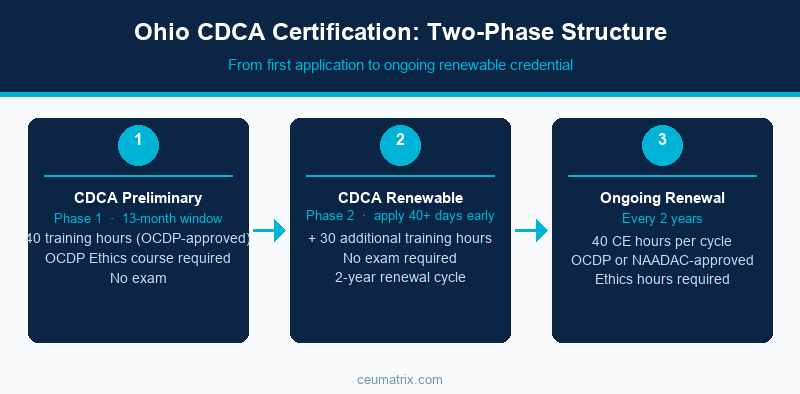
Unlike most state credentials, which have a single application path, Ohio’s CDCA comes in two sequential phases.
Phase 1: CDCA Preliminary
The CDCA Preliminary is a temporary certification valid for 13 months. Requirements:
- 40 hours of Substance Use Disorder (SUD) education in required content areas
- Ethics education: the required legal & ethical content area (as of July 1, 2026, the OCDP no longer requires the separate one-hour Board ethics course to be completed and submitted with your application — a Board-approved bundle covers this requirement)
- 50% of coursework must be completed within 2 years before the application date if using approved training course credits, or 5 years if using college or university courses
You can apply for the CDCA Preliminary while still accumulating hours, but at least half of your hours must fall within the applicable timeframe at the time of application.
Phase 2: CDCA Renewable
You may apply for the CDCA Renewable after you have held the Preliminary for at least 10 months. Plan to submit your CDCA Renewable application at least 40 business days (~2.5 months) before your Preliminary expires — the Preliminary is valid for 13 months total and cannot be renewed. Before applying, you must complete an additional 30 hours of required training on top of your Preliminary education. The CDCA Renewable is the ongoing, renewable credential (renewed every two years).
Processing takes time, and late applications risk a gap in your certification status.
2026 Education Requirement Change
Starting July 1, 2026, the OCDP is changing how education hours can be completed for initial CDCA certification. Under the new rule:
Effective July 1, 2026, all initial CDCA Preliminary and CDCA education hours must be completed through either:
- Accredited college or university courses, OR
- An OCDP Board-approved CDCA Bundle
Generic continuing education credits that were previously accepted for the initial CDCA will no longer qualify. If you are applying on or after July 1, 2026, verify that your education source is a board-approved Bundle or a recognized college course.
This change does not affect renewal CE hours for existing CDCA holders. It applies only to the initial certification pathway.
The Board is also discontinuing the CDCA Preliminary and CDCA education grids for new applications as of that date. Applicants no longer complete and submit a grid — they enroll in an approved Bundle and submit certificates of completion. Read the full breakdown of the July 1, 2026 Ohio CDCA changes.
CEU Matrix offers OCDP-approved Ohio CDCA courses, including Phase 1 training bundles designed specifically to meet these updated requirements. As OCDP Provider #50-19236, CEU Matrix courses are accepted for Ohio CDCA certification.
Required Content Areas
The 40-hour CDCA Preliminary education must cover specific OCDP-required content areas:
- Substance use disorder fundamentals and pharmacology
- Assessment and screening
- Treatment planning
- Counseling theory and techniques
- Professional ethics (including the board’s mandatory free ethics course)
- Cultural competency
- Co-occurring disorders
- Documentation and case management
The additional 30 hours for the CDCA Renewable expand on these areas and may include supervision topics and advanced practice content.
Application Steps
For CDCA Preliminary:
- Complete 40 hours of OCDP-approved SUD education
- Complete the OCDP Ethics Committee’s free mandatory ethics course
- Create an account at the OCDP’s online credentialing portal
- Request a BCI (Bureau of Criminal Investigation) background check be sent directly to the OCDP Board — this is Step 3 of the official application and is mandatory for CDCA certification
- Submit your application with: education documentation, certificates of completion, and employer information if applicable
- Receive your CDCA Preliminary certificate, valid 13 months from issuance
For CDCA Renewable:
- Within your CDCA Preliminary validity period, complete the additional 30 required training hours
- Submit the CDCA Renewable application at least 40 business days before your Preliminary expires
- Include documentation of your additional 30 hours
- Receive your CDCA Renewable, valid 2 years, then renews with CE hours
CDCA Renewal Requirements
The CDCA Renewable requires 30 hours of field-related continuing education every 2 years, including at least 6 hours of SUD-specific content and at least 3 hours of ethics. Ohio accepts CE hours from NAADAC-approved providers, OCDP-approved providers, and several state-accepted sources. CEU Matrix covers all renewal categories, with ethics, co-occurring disorders, and substance-specific courses available in self-paced online format.
The CDCA renewal hours grid in Ohio breaks down each required content category, the minimum hours for each, and how to complete the full cycle online.
How Long Does CDCA Take?
Timeline from start to CDCA Renewable:
| Stage | Typical Duration |
|---|---|
| Complete 40 Preliminary hours | 2 to 8 weeks (self-paced) |
| Application processing | 2 to 6 weeks |
| CDCA Preliminary valid period | 13 months |
| Complete 30 additional hours | 1 to 4 weeks |
| CDCA Renewable application | Submit 40 business days before expiry |
Most counselors who work through the education at a steady pace can have their CDCA Preliminary in hand within 3 to 4 months of starting.
No Exam Required
One significant difference between the CDCA and credentials in other states: Ohio’s CDCA does not require a written certification exam. The IC&RC ADC exam is required for the LCDC II, not the CDCA. This makes the CDCA more accessible as an entry point for counselors who are newer to the field.
If you are still navigating the initial 13-month window, Ohio’s CDCA Preliminary status and the training requirements that convert it to the Renewable are covered in detail.
What the 40 Required Hours Cover
The 40-hour CDCA Preliminary requirement is not a single block of generic SUD training. OCDP specifies content areas that must be covered, and board-approved bundles are structured to address each of them. Here is what those areas include and why each one matters for an entry-level counselor.
SUD Fundamentals and Pharmacology
This is the scientific backbone of the credential. Courses cover how different substances work in the brain and body, the mechanisms of tolerance and physical dependence, the signs and symptoms of active use for alcohol, opioids, stimulants, benzodiazepines, cannabis, and other substances, and what withdrawal looks like across drug classes. Counselors who understand pharmacology are better equipped to recognize what clients are experiencing and to communicate clearly with medical and psychiatric staff.
DSM Diagnostic Framework for SUD
Ohio programs use the DSM-5 criteria for substance use disorders. The training covers how the diagnostic criteria map to mild, moderate, and severe classifications, why the old dependence/abuse distinction matters historically, and how diagnostic language affects treatment planning and insurance authorization. Entry-level counselors are not diagnosing clients independently, but they need to understand the framework their supervisors and clinical directors are working within.
Basic Counseling Skills and Theory
This area covers foundational therapeutic orientations as they apply specifically to addiction treatment: motivational interviewing, cognitive-behavioral approaches, stages of change, and person-centered principles. The training is not intended to produce licensed therapists, but it gives CDCA candidates practical skills for establishing rapport, conducting supportive conversations, and avoiding common pitfalls like confrontation and unsolicited advice.
Assessment and Screening Instruments
Initial screening is one of the first tasks CDCA holders perform in many Ohio programs. The training covers how to conduct a structured intake screening and introduces the validated instruments used widely across Ohio: the AUDIT (Alcohol Use Disorders Identification Test), the DAST (Drug Abuse Screening Test), the CAGE questionnaire for alcohol, and UNCOPE, which is used in Ohio’s correctional and diversion settings. Knowing how to administer these correctly and interpret the scores is a practical, day-one skill.
Documentation and Record-Keeping
Ohio licensed SUD programs operate under specific documentation standards, and entry-level staff are responsible for accurate, timely records. The training covers what belongs in a client file, how to write progress notes that meet regulatory and billing requirements, confidentiality rules under 42 CFR Part 2 (which applies specifically to SUD records), and how documentation practices protect both the client and the counselor.
Co-Occurring Disorders
A significant portion of SUD clients in Ohio programs also carry mental health diagnoses, including depression, anxiety, PTSD, and bipolar disorder. The co-occurring content area covers how mental health conditions interact with substance use, what integrated care looks like versus siloed treatment, and how CDCA holders can recognize behavioral health needs that require escalation to clinical or psychiatric staff.
Professional Ethics
OCDP requires completion of a specific mandatory free ethics course offered by the board’s Ethics Committee. This course is Ohio-specific and is not interchangeable with a generic ethics CE from another provider. It covers the OCDP code of conduct, mandatory reporting obligations, dual relationships, scope of practice for the CDCA credential, and the process for filing complaints. The certificate from this course must be submitted with the CDCA Preliminary application.
Supervised Hours Planning and Documentation
While the 40-hour training does not itself include supervised practice, a well-designed bundle prepares candidates to set up their supervision arrangement correctly from the start. That includes understanding what qualifies as a supervision session under OCDP rules, how to document supervision in a way the board will accept, who can serve as a qualifying supervisor, and the errors that most commonly delay or complicate applications during the supervised experience phase.
CEU Matrix is OCDP Provider #50-19236 and offers board-approved CDCA bundles that are structured around these content areas. Courses are self-paced, and certificates are delivered immediately upon completion, so candidates can submit documentation to the board as each course is finished rather than waiting for an entire program to wrap.
CDCA to LCDC: Building Your Career Path in Ohio
The CDCA is a supervised credential, meaning holders work under the oversight of a licensed professional rather than practicing independently. That structure is intentional: the CDCA period is designed to be a foundation-building phase, and counselors who use it strategically put themselves in a much stronger position when they apply for the LCDC II.
What CDCA holders do in the field. Most Ohio SUD programs rely heavily on CDCA staff for intake screening, group facilitation support, case management coordination, and direct client interaction under supervision. CDCA holders are the entry point for most clinical teams, and program directors actively hire at this level because the credential indicates foundational training and board accountability.
The LCDC II requirements. To advance from CDCA to Licensed Chemical Dependency Counselor II, Ohio requires: an associate degree or higher in a relevant field, a substantially greater number of supervised clinical hours than what is required for the CDCA, and a passing score on the IC&RC ADC (Alcohol and Drug Counselor) exam. The IC&RC ADC is a nationally recognized exam administered through a third-party testing center, and it tests candidates on domains including clinical evaluation, treatment planning, referral, service coordination, counseling, client education, documentation, and professional and ethical responsibilities.
Using the CDCA period strategically. Counselors who know they want the LCDC II should treat the CDCA phase as an active runway, not a waiting period. The most effective approach is to pursue an associate or bachelor’s degree in social work, human services, psychology, or a related field while working under the CDCA, so the education requirement is met by the time supervised hours are complete. A diverse client caseload during this phase, across different presenting issues and treatment modalities, makes a stronger application and better prepares the counselor for the ADC exam content.
The LCDC III for advanced practice. Ohio’s credential ladder has one more step above the LCDC II. The LCDC III requires the LCDC II credential, additional supervised experience hours at the licensed level, and passage of an advanced clinical exam. The LCDC III is the credential required for clinical supervision roles and independent practice, meaning LCDC III holders can operate without oversight and can supervise CDCA and LCDC II staff in turn. For counselors with long-term career goals that include clinical director positions, private practice, or training and supervision, the LCDC III is the target.
Ohio’s SUD workforce demand. Ohio has one of the highest rates of substance use disorder treatment need in the country, and the licensed counselor workforce has not kept pace with demand. CDCA holders who advance to LCDC II and LCDC III can expect meaningfully higher compensation, broader role options including telehealth and independent practice, and greater job stability. The credentialing investment made at the CDCA level compounds over time.
Counselors unsure whether to target the LCDC II directly or enter through the CDCA can compare the education, exam, and salary differences between the CDCA and LCDC in Ohio before choosing a path.
CEU Matrix supports both the CDCA initial training and LCDC renewal with OCDP-approved self-paced courses, so counselors can move through the credential ladder without coordinating around in-person schedules.